
Readable and tactical combat for a collectible trading card game
Origins TCG was Koin Games' card battler built around collectible characters, locations, ability timing, and fast combat resolution. My work focused on turning complex systems into readable rules, usable feedback, progression hooks, and implementation-ready specs for design, engineering, UI, VFX, and audio.

From Auto-Chess Prototype to F2P Competitive TCG
The initial prototype explored a Clash Mini-style auto-chess model because it looked like a strong starting point for our collection, trading, and F2P monetization goals. Our approach pushed that model through board positioning, opening abilities, targeting, and status/combat clarity, with the intent of making the format more readable and strategically expressive.
That work exposed the real design problem: too much of the strategy happened before players could clearly read, predict, or influence the payoff. Meaningful strategy was not showing up equally across each stage of the match, and we could not find a version of the auto-chess loop that made the core play more fun.
When we pivoted, Origins TCG kept the strongest ingredients: collectible characters, ability combos, keywords, progression, and readable combat feedback. The setting also shifted from our hand-written worldbuilding into public-domain-driven IP, giving the project a clearer content strategy for a F2P competitive card game. The fun moved toward deckbuilding, card sequencing, locations, and clearer player-authored decisions during the match.

Systems design across play and progression
My work moved through several overlapping stages: defining the card-game frame, making combat readable, specifying player interaction, and connecting match outcomes to collection and progression. The throughline was clarity at both scales: players needed useful information before, during, and after a card resolved, while long-term goals needed to stay visible through collection, upgrades, rewards, and unlock pacing.
Card identity without losing board clarity
Cards needed unique visual identities through both 2D art and VFX, including ability moments and flavor beats, so readability stayed on our minds as we iterated. My work kept pressure-testing whether card identity, board state, combat order, and effect feedback could coexist without burying the player's next useful decision.

Card game structure
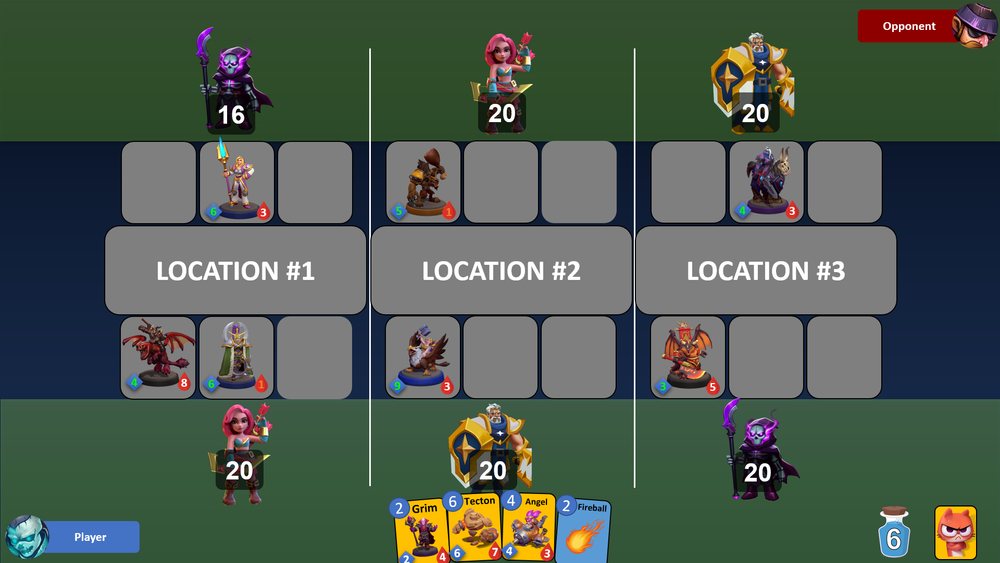
Specified objectives, gameplay phases, hand/deck/mana behavior, card states, locations, and on-board unit representation. That foundation supported the first keywords, ability interactions, and 50+ early cards used to prove out the model.

Keywords and execution rules
Defined reusable condition/effect keywords, ability hosts, ordering rules, out-of-phase behavior, and edge cases so card text could stay concise while combat logic stayed deterministic.
Reveal timing and keyword feedback
Worked through reveal timing, keyword icon visibility, card/board feedback, and status-effect presentation so players could follow the chain of effects, understand how the board state changed across a round, and prepare for the next placement phase.

Targeting and board feedback
Documented drag/drop behavior, hover states for cards in hand and units on board, valid target highlights, emote UX, player action feedback, location pressure, and ability indicators so decisions stayed readable before and after a card resolved.

Logical opponent decisions
Outlined lethal checks, offensive/defensive turn selection, mana efficiency, location awareness, and first-pass simulation priorities for a beginner bot. The goal was fewer predictable failures and more predictable successes, creating a PvE opponent that felt closer to player-vs-player decision pressure.

Collection and upgrade framing
Connected collection XP, series unlocks, upgrades, reward framing, and higher-stakes modes into progression concepts that could be tuned after the core loop was understood.
Representative written work
Selected specs that show how I translated combat, interaction, progression, and content-pipeline problems into implementation-ready design work. Each sample is organized by the design question it helped answer, so reviewers can skim the page first and open the deeper PDF when relevant.
Abilities & Keywords
Reusable ability language, condition/effect keywords, card text constraints, and execution-order considerations.
View deliverableAbility Priority & Flow
Combat timing, ordering, triggered abilities, overlapping windows, and rules that make outcomes consistent.
View deliverableStatus, VFX, and Feedback
Prototype-era Clash Mini-style status-effect and VFX spec covering buff/debuff presentation, combat-frame application, reveal feedback, icon states, and readability support that informed later TCG feedback work.
View deliverableBot AI and Simulation
First-pass opponent logic for lethal checks, mana use, location pressure, and readable beginner behavior.
View deliverableMerge and Upgrade Systems
Upgrade-level logic, package selection, visual feedback, and player-choice flow for in-match unit development.
View deliverableFuture Mechanics Planning
Forward-looking space for reusable mechanic growth, keyword expansion, and design-system scalability.
View deliverable